


Lume to End All Lume
It’s no surprise that after nearly three years since it entered the scene, Projekt 01 has become somewhat synonymous with lume. While this was never the objective, Projekt 01 has paved the way for luminescent pigments to be used much more creatively than as mere functional dial elements. 2025 saw the advent of Lichtblock™, kollokium’s proprietary luminescent ceramic-resin
hybrid material. This development allows lume to take on a much more prominent role and, given the sheer amount of luminescent pigments found across the hundreds of individually hand-applied cylindrical pins, a level of glow that’s frankly unheard of.
Typically, one gramme of Super-LumiNova powder can be used to create between 200 and 300 traditional dials with the usual 12 pad-printed hour markers. In Projekt 01 Variant H, 2 grammes of Super-LumiNova are required for each dial. That’s not to say that the dial will glow 500x brighter than a
traditional dial, but the difference is hard to miss. Across the 488 pin elements in 6 different diameters and heights as well as the hour and minute hands with Lichtblock™ elements, there’s the equivalent amount of lume as nearly 500 traditional pad-printed dials with luminescent markers.

Kollokium
Projekt 01 - Variant "H"
Share


One Last Time
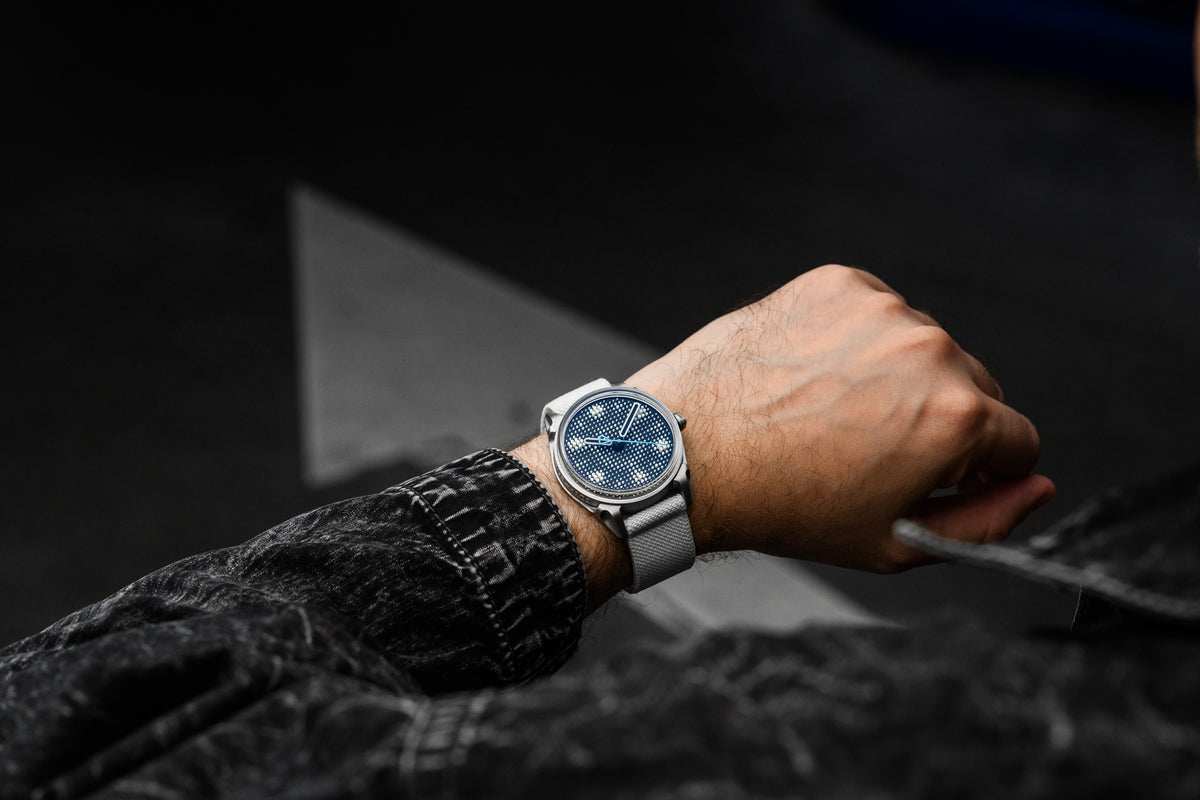
kollokium is certainly making the last one count. Projekt 01 Variant “H” is closing the circle that began in 2023 with the Projekt 01 Friends & Family edition in the most electrifying way. A return to the source, but with three years worth of introspection and evolution to really mark the milestone. And, to really set things off with fireworks, more lume on the dial than anything that has come before.
Projekt 01 Variant “H” celebrates everything that has made kollokium’s model so emblematic from the get-go, but with some added flair. The unmistakably neubrutalist design language, the die-cast steel case with box sapphire crystal and the highly graphical dial full of Lichtblock™ pins all come together for a final, matured rendition of alternative watch design.
